
The Moon's phases, from new to full and back
What illumination tells us, and how the familiar phase names fit together.
Dear Reader,
Have you ever watched the Moon change shape and wondered what is actually changing?
The Moon reflects sunlight. As it travels around Earth, we see changing portions of its sunlit half. This creates the familiar sequence of lunar phases. Ordinary phases are not caused by Earth's shadow.
Four familiar landmarks
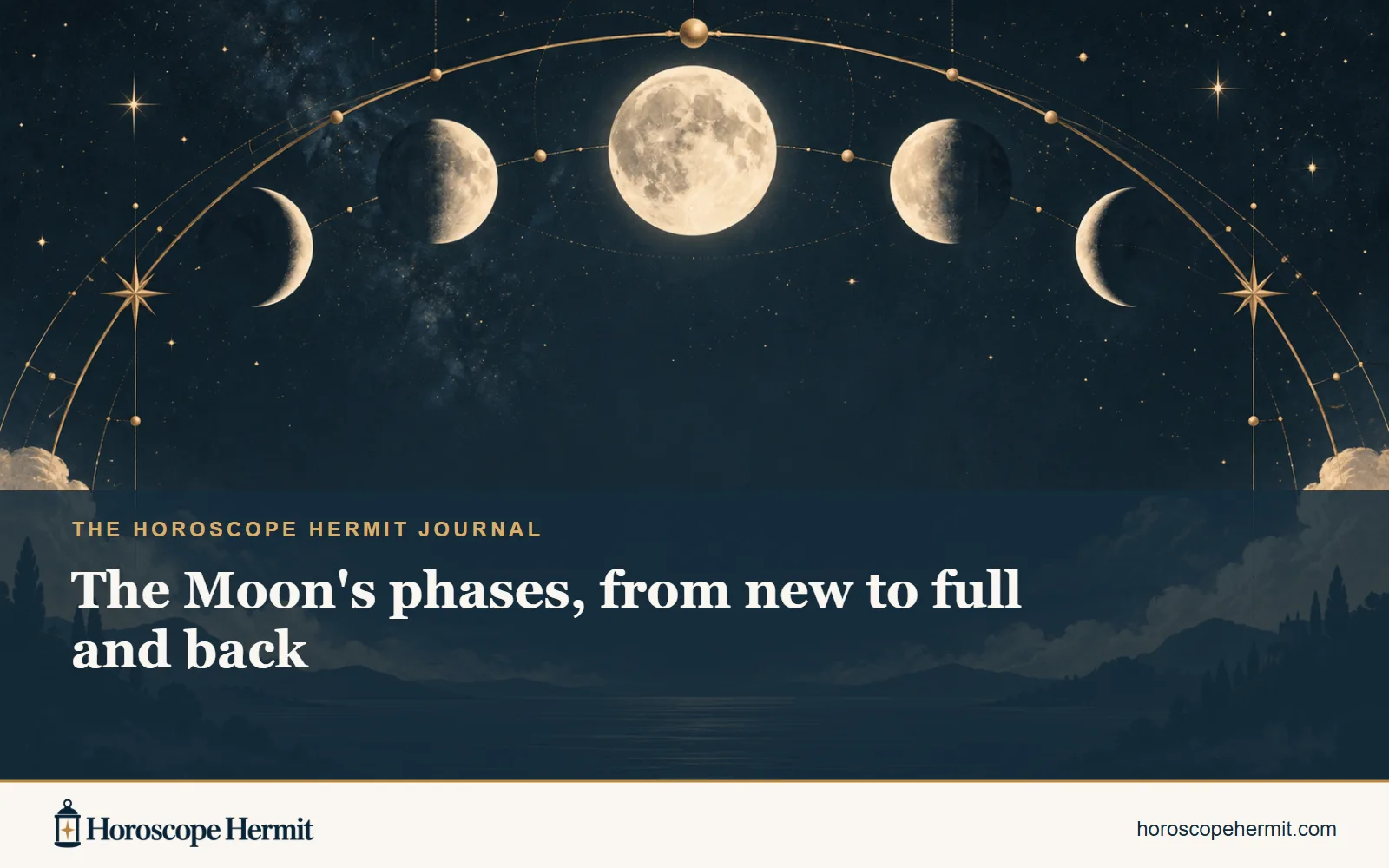
At new Moon, the Moon is near the Sun in our sky, and its sunlit side faces away from us. As it moves around Earth, more of that bright side comes into view. At first quarter, half the disc looks lit. At full Moon, we see nearly all of its sunlit side. Then the visible light shrinks, passing through last quarter on the way to the next new Moon.
You'll often hear the words waxing and waning. Waxing means the part that looks lit is growing. Waning means it's shrinking. The full cycle takes about 29.5 days, so it doesn't fit neatly into a calendar month.
Why eclipses do not happen every month
The Moon's orbit is tilted. At most new Moons it passes above or below the Sun from our point of view. At most full Moons it misses Earth's shadow. An eclipse needs a closer alignment, which is why a new Moon or full Moon doesn't always bring one.
Observation and interpretation
The phase and illumination are observable. The meanings people attach to the cycle are interpretations. Some use a new Moon as a time to begin and a full Moon as a time to review. Those practices may create a useful rhythm, but the Moon does not physically require everyone to follow the same schedule.
If you'd like to try this, choose something small at the new Moon. Perhaps you've been meaning to spend half an hour a week on a hobby. At the full Moon, look back. Did you make the time? What got in the way? You can adjust your plan on any day; you don't have to wait for the Moon to reach another phase.